Hugo Fontela (Grado, Asturias, 1986) began his studies at the Avilés School of Fine Arts and Crafts, where he learned the rudiments of painting from the artist Favila. His early works focus on natural settings that have been transformed by man and exude a certain industrial feel. Once he turned 18, he made the leap to New York, where he would live until 2014. There, his paintings begin to capture ideas rather than specific places. His artistic tone moves away from the industrial landscapes of his early works and begins to veer towards a kind of oriental lyricism. New York left its mark on Fontela’s work in two ways. Firstly, there was a change of scale as he began to adopt significantly larger formats. Secondly, he was clearly inspired by American painters such as Rothko, Kline, Motherwell, De Kooning, Cy Twombly, Guston or Resnick, who seem to occupy a special space alongside his fondness for the works of Sorolla, Beruete, Morandi, Reverón, Monet and Esteban Vicente himself.
By 2006, nature had begun to timidly burst out in his works, as we can see in his Piers series on the Hudson River or his Back Yards of the Village. But it would not be until 2010, following a trip to the coasts of the Gulf of Mexico, that nature would really start to take centre stage. The first of these series centres on the trunks of palm trees, stranded along vast stretches of white sand. This was followed by a series of islands, taking blue and water as central elements, and rocks emerging from the sea. From 2020 onwards, green becomes ever-present, depicting a nature that is bursting and overflowing and requires no other compositional element.
The Hugo Fontela exhibition. Notes for a Paradise presents a collection of thoughts and moments in time that the artist wanted to capture before they vanished. In this series, instead of trying to tell us something, the artist searches for the essence of painting by attempting to capture the transience of those thoughts and moments. Think of painting as a place, a paradise where painting embraces nature and vice versa.
These notes are given their spatial expression in three series produced between 2020 and 2023: River, Green and Paradise. Between them, there is a gentle transition, in contrast with the sharp shifts seen in earlier works. Similarly, Fontela’s rigorous working method that defined his previous work has been gradually diluted. While the initial inspirational spark or impulse is still based on reality, he now liberates himself from order and rationality to allow his creativity to flow in total freedom.
His works are highly gestural, using rapid brushstrokes to gradually superimpose subtle layers that ultimately create a kind of accentuated lyricism. Brush, hands, fingers: following a veritable melée with the canvas, the artist’s imprint can be felt throughout the composition.
River begins with the memory of a river in Asturias emerging from the undergrowth. The series flows along a path marked by photographs of the river that the artist took as a teenager. In each piece, plant life and the aquatic merge together, as powerfully enhanced by the reflections, creating just a thin line separating reality from fiction. In this series, he returns to oil painting, a technique he had long abandoned in favour of acrylics. This allows him to work at a slower pace and multiply the nuances, light effects and embodiment of the painting.
In that search for the essence of painting, Fontela also began his Green series, which is a continuation of the cycle initiated in River. In this collection of large-format pieces, the boundary between reality and abstraction is completely dissolved. Sometimes, the painting does not cover the entire surface, leaving apparent untouched margins around the edges. The sinuous brushstrokes of green, white and blue create confusing horizons, where the sky melts into the water and the water into the sky. Not so with the vegetation, which boldly bursts out and begins to overflow and dissolve into the lower margin, producing in an endless fade and allowing the painting to break free from the limits of the frame. This series also shares an interesting connection with Cy Twombly’s 1986 series Green paintings, which was never exhibited and also features an ambiguous boundary between the painting and the frame.
The third series, Paradise, continues along the same path as Green, evoking what that artist sees as paradise through painting: “nature as paradise, painting as paradise”. These works reflect the artist’s joy at having found his place in the world through painting. In these most recent works, we find a sincere, more profound painter who is less inhibited. They include a new, more panoramic format that almost zooms in to bring the observer closer, almost immersed in the natural environment. If we look closely, it is possible to glimpse a work full of chromatic nuances, carmine, yellow, blue, green and whites that are not really there, all conjured up according to the basic natural principles that so inspire the artist: fluidity, rhythm and balance.
The exhibition also includes an interesting collection of works on paper, where it is possible to see the artist’s initial attempts before turning to face the emptiness of the large canvas.
Hugo Fontela is a PAINTER dedicated to a single genre, the LANDSCAPE, avoiding the explicit depiction of figures without ignoring their presence completely. “I propose landscapes to live in them or walk through them,” he claims. “I don’t like to impose an already inhabited landscape on anyone. You can enter alone or accompanied. This way, the painting becomes a big stage, an empty theatre open to anyone”.
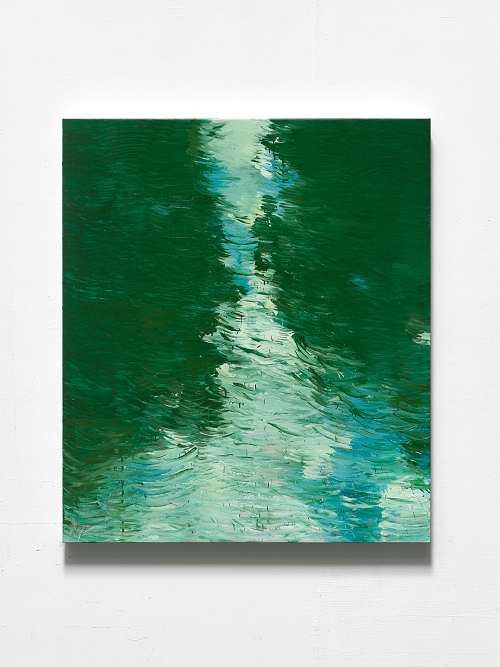
River 11, 2021
Óleo sobre lienzo, 150 x 130 cm
© Hugo Fontela, VEGAP, Segovia, 2024
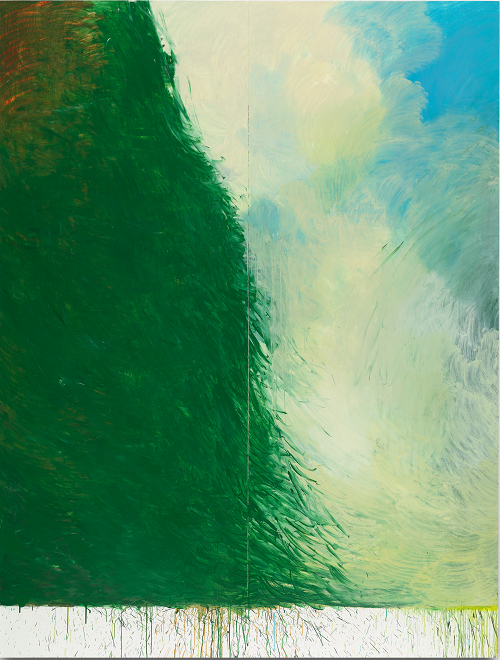
Green 11 (Green Painting I), 2022
Óleo sobre tabla, 265 x 200 cm
© Hugo Fontela, VEGAP, Segovia, 2024
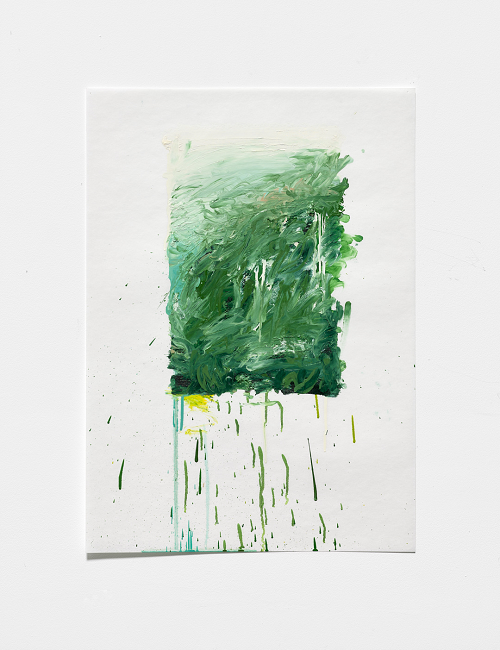
Paradise 8, 2022
Óleo sobre papel, 70 x 50 cm
© Hugo Fontela, VEGAP, Segovia, 2024