
MON MONTOYA
The Nest of blackbirds
February 9 – May 19, 2013
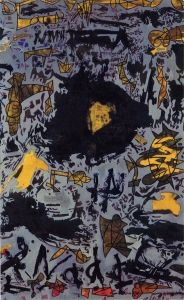
“The blackbirds (my neighbors in the trees) sing dual and optimistic songs in spring. They greet the morning with their symphony and live in their ephemeral nests. They adopt the look of little gentlemen high atop the smokeless chimneys and on the rooftops of the towns, full of humility. After their trill there remains the emptiness of their free sounds. I suspect that nothing occupies their lovely spaces. We remain gone and broken.” Thus does Mon Montoya (Mérida, 1947) define the birds, with their highly-varied aspect and extraordinary songs, which have inspired the title of the monographic exhibition presented by the Museo de Arte Contemporáneo Esteban Vicente.
As always in this artist’s work, the choice of this generic title, that could seem arbitrary for being merely poetic, is not generic at all. The set of works which make up the show is, unquestionably, like a nest of blackbirds. These elusive birds, whose natural habitat are forests and groves, also settle in areas near human beings, where they easily adapt themselves, becoming intrepid and flirty, multiplying in gardens and the metropolitan underbrush. Therefore, effectively, they are a metaphor of the work developed by Mon Montoya in recent years, with its natural and urban echoes, melancholy and at the same time spontaneous, loyal to his idiosyncrasy but full of surprises.
The exhibit, nonetheless, has a prologue that is relatively distant in time, although not in conception. It begins with a series of works made between 2000 and 2003, as a result of his trips to the United States and China. Distance, both physical and emotional, and the discovery of new landscapes and states of mind, and, later, the return and the need for readjusting, materialize in a turning point in his work, emphasized by a meticulous study of color, geometric composition and the purity of gesture, with a continually increasing vocation for pure and gestural abstraction. All these components were accentuated during his stay at the Yaddo Foundation (Saratoga Springs, New York) in 2002, sponsored by the Harriet & Esteban Vicente Foundation; the contrast between his quiet work space and the destruction of the World Trade Center a few months earlier inspired the compositions collected under the joint title of The Bird House: the bird houses substituted the wounded city, sheltering all the annihilated souls.
That spirit is extended across time and space, as is usual for the artist, and is again present in the fundamental nucleus of this exhibit, made up of canvases and works on paper created, almost without exception, between 2007 and 2012 and for the most part unpublished. There are a series of arguments and ideas that, with meanderings and derivations, permeate Mon Montoya’s work: “I get excited at some point during the day. Possibly, all those emotional events wind up accumulating to appear at a decisive moment when they converge, many of them filtered by what I think and dream about a specific subject.” Thus, we see a reappearance of some of the concepts that have most concerned and inspired him, and which, in recent years, have consolidated their presence in the imagery of the painter, whose creative process, in his own words, has become slower and more contained. Memory understood as the patient archive of experiences, concerns, places visited and the perspectives they offer, all this given shape in chapels, houses, boats. Poetry, as the essential verbalization of emotions, traverses the textures, the trees of ashes, the nests of blackbirds, the more “material” aspect of the artist’s work. And always, death, that “most intimate conscience”, fait accompli that can only be accepted, and with which the poet lives, with an irony and vitality that are innate for him, present in hisbullfights, rescues, and paradises for the content.
Mon Montoya lives and works in Segovia since 1974