
GAMES IN SPACE
January, 29 – May, 5 2002
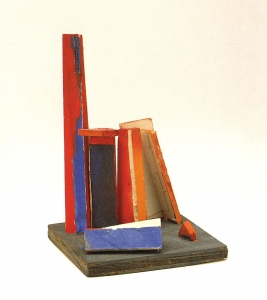
Esteban Vicente began his artistic career in 1921 as a student at the Academia de Bellas Artes de San Fernando in Madrid with the intention of becoming a sculptor. Very early on he abandoned that idea, seduced by the agility and power of painting. Nevertheless, throughout his life he always maintained a sensibility towards spacial values, a feeling that is reflected in these works. Although their appearance is deceptively simple, they are, however, the result of a profound command of the composition of planes and colors. They carry on a silent dialogue with several important moments in twentieth-century art: naturally, with Cubism, but also with Constructivism. Thus, they are magnificent exponents of the way the values of modern art are incarnated in a type of creation that is neither heroic nor grandiloquent. While the development of the compositive plane in three dimensions was already present at the beginning of Cubism, the carefree nature of these little sculptures is reminiscent of the idea of artistic creation as a game, present in the works of Torres García or Paul Klee. The fact that the artist himself called them “Toys” or “”Divertimentos”, gives us an idea of what he thought of them. They are, in effect, “games in space.”
Done over a long period of time, these small sculptures are particularly interesting in that they are examples of the artist´s attitude towards a creation free from convention. On the other hand, they are also an exceptional counterpoint to his work as a painter and creator of collages, since they are something like free-standing, three-dimensional collages. In the Museum we have attempted to show this relation by placing the “Toys” alongside a representative sample of the rest of his work.
This exposition consists of 16 small sculptures belonging to the Museo de Arte Contemporáneo Esteban Vicente together with others from important collections in Spain and America. To these, we should add the extensive collection belonging to Harriet G. Vicente, the widow of the artist. In all, they total 79 works which are a veritable visual delight, in which we can find abstract forms alongside allusions to animal or anthropomorphic shapes.
Esteban Vicente (Turégano, 1903 – New York, 2001) began his artistic career in the Madrid of the 1920s where, among his friends were some of the most outstanding members of the Generation of 1927. During those years he practiced a type of poetic painting similar to that of Juan Bonafé or Francisco Bores. After several trips to Barcelona and Paris where he acquired a first-hand knowledge of the avant-garde artistic currents of the moment, he left for America in 1936. As a member of the New York artistic scene, his painting gradually evolved towards abstraction. While his paintings done at the beginning of the 50s show the influence of De Kooning, Rothko or Guston, he soon began to find his own personal style. This work is characterized by a marked spacial sense, an unconventional chromatism and a lyrical bent, very alien to the more dramatic works of his fellow artists. As the sole Spanish member of the New York School of Abstract Expressionism, he also did collages, which some critics have valued very highly within his entire body of work. In addition, his work as a teacher was also important, having taught painting at the most prestigious American institutions, including the Black Mountain College.
Although he never returned to Spain definitively, he obtained the highest recognition for his artistic work that was awarded in this country. The Museo de Arte Contemporáneo Esteban Vicente was inaugurated in 1999 , the basis of which is a large and representative donation of works that include the various languages and stages in his artistic trajectory.