“The motionless surface has no time.”
With these words, written by Elias Crespin upon completing Malla Electrocinética I in 2004, begins the journey proposed by this exhibition. In that brief poem, now regarded as a kind of founding manifesto for his career, the artist imagines a surface suspended in space, motionless and frozen outside of time. But immediately a yearning arises: for that surface to come alive, change, and transform. To acquire time, it must mutate, losing a small part of itself to become, moment by moment, something new.
That desire to give geometry time marks the origin of Crespin’s work and becomes one of the keys to experiencing this exhibition.
Born in Caracas in 1965, the grandson of artists and the son of mathematicians, Elias Crespin belongs to a generation that has renewed the legacy of Venezuelan kinetic art. His work establishes a dialog with the pioneering explorations of Jesús Rafael Soto, Carlos Cruz-Diez, Alejandro Otero, and Gego, essential figures in Venezuelan kinetic art of the second half of the 20th century. At the same time, his sculptures can be linked to the electrokinetic tradition that brought motors and mechanical systems into the language of sculpture, as Jean Tinguely, Julio Le Parc, Gianni Colombo or Nicolas Schöffer. Crespin takes this a step further by incorporating computer programming and electronic precision to “draw” sculptures that evolve over time as if they were living organisms. In this sense, his work can also be seen as continuing the pioneering research in computational art developed since the 1960s by artists such as Vera Molnar and Manfred Mohr, who found in algorithms a new tool for exploring the possibilities of geometry. However, while those works took shape primarily as drawings, graphics, or two-dimensional compositions produced through plotter printing, Crespin transfers those processes to physical space and gives them a temporal and choreographic dimension. The structures unfold and fold back in a rhythm that transforms space into a breathing pattern. It is precisely this vital, immaterial dimension that the exhibition’s title, Pneuma. The Silences of Movement evokes.
Pneuma is a Greek word meaning breath, wind, breathing, or spirit. In Stoicism, it was described as the invisible force that permeated and held the universe together. It was the vital principle that organized the cosmos and allowed the continuous transformation of matter without destroying its identity. The subtitle, The Silences of Movement, refers to those intervals of pause, suspension, and transition where that invisible energy becomes perceptible. As with breathing, the moments that separate inhalation from exhalation are just as important as inhalation or exhalation itself. The silences of movement also evoke John Cage’s reflections on the nature of silence. Following his famous experience in Harvard University’s anechoic chamber, Cage concluded that absolute silence does not exist; even in the absence of deliberate action, we continue to perceive the activity of the world and of our own bodies. His work thus shifted attention from the main event toward the conditions that make it possible. Something similar happens in Crespin’s work. Moments of apparent stillness are spaces of perceptual density where time becomes visible. It is there that transformation takes shape, where a form ceases to be what it was and slowly becomes another.
Although powered by motors, software, and high-precision mechanical systems, the transformations of his creations do not feel cold. They feel organic, as if an inner respiration, a breath (pneuma), guided every movement. The pieces expand, contract, pause, reorganize, and unfold once again, following rhythms that evoke natural phenomena rather than technological processes.
Here, one of the central tensions of the exhibition comes to the fore. Technology acts as a hidden current that animates the work, but the encounter with it takes place in the realm of sensory experience. Slow movement calls for an attentive, contemplative gaze, especially in an age dominated by speed and the instant consumption of images.
As we move through the exhibition, we discover that his pieces unfold like a musical composition, a visual score, or a choreographic sequence. Like a draftsman of the air, Crespin traces lines in space and turns them into temporal events. Grids, circles, triangles, or squares cease to be static figures and become suspended gestures. Like an invisible puppeteer, he activates strings, tensions, counterweights, and motors that allow the forms to free themselves from stillness. Without touching them directly, he guides them through carefully programmed sequences, making each element take part in a complex collective choreography.
Malla Electrocinética I, 2002-2004, opens the exhibition journey and serves as a conceptual seed. A simple suspended grid that holds the essential questions at the heart of his research. How to introduce time into geometry, how to make a surface mutate without ceasing to be itself, how to turn a mathematical structure into a sensory experience.
The Circuconcéntricos series stands as one of the most eloquent examples of this pursuit. Composed of suspended circles that slowly draw together, drift apart, expand, and contract, these works evoke patterns found in nature, such as planetary orbits, gravitational systems, ripples on water, cells in the process of division, or biological clusters subject to forces of attraction and repulsion. In its Fluo version, the incorporation of luminescent color intensifies the perceptual experience and activates the surrounding space. The circles become interacting bodies, drawn to one another by a force of attraction, and transforming as if obeying invisible laws.
The Tetralineados series, one of the artist’s most recognizable works, is based on suspended linear structures organized into parallel vertical modules made of materials such as aluminum, brass, or Plexiglas that, when observed over an extended period, evoke musical scores or abstract writing. Crespin’s works apply musical concepts such as rhythm, tempo, repetition, counterpoint, variation, and pause. The algorithms that control each piece function like precise musical staves capable of organizing complex temporal sequences. In Crespin’s practice, an essential part of the sculptural process shifts to software, where the timing, speeds, phase shifts, and relationships between its various components are defined. The code becomes an expanded score in which the work exists before physically manifesting in space. Drawing on mathematical relationships, the artist constructs complex sequences of movement that generate configurations in constant transformation. Like a composer combining notes to build chords, the artist articulates “choreographic chords”: sets of simultaneous trajectories that resonate with one another and produce a constantly transforming visual experience.
Dance, too, emerges as a point of reference. As in contemporary dance, what matters is not only the final position of the bodies, but also the trajectories they follow to reach it. The true event occurs between one form and another. It is in those in-between moments, in those almost imperceptible spaces of transition, where Crespin’s deepest language lies.
Although nature is not represented literally, it is another source of inspiration for his work. From it, he adopts some of its fundamental structural principles, such as growth, repetition, mutation, balance, and transformation. This dimension is especially evident in TriNet, 2011. Composed of a complex network of triangular elements that endlessly organize and disorganize themselves, the work behaves like a microcosm in perpetual metamorphosis. Its programmed movements generate patterns that evoke constellations, plant structures, and fractal geometries found in numerous natural phenomena. Throughout the exhibition, the importance of materials becomes evident. Stainless steel, aluminum, brass, Plexiglas, nylon, light, shadow, and color actively participate in the construction of each perceptual experience. Each material brings a specific relationship with light and space. Within this context, the collaborations undertaken with Felipe Pantone take on special significance. Cubo Pantone, 2021 and Chromadynamica Flexionante, 2022, represent the convergence of Crespin’s spatiotemporal exploration with the chromatic research of Pantone, one of the artists who has most compellingly captured the speed, transformation, and digital culture of our time in visual form.
Pantone’s contribution to Crespin’s work helps turn color into an active agent in the composition. Chromatic gradations and contrasts heighten the sensation of movement and generate shifting perceptual phenomena. Movement and color become complementary manifestations of the same energy.
One of the most recent and striking pieces in the exhibition is La danza de las catenarias II, 2024, in which Crespin incorporates wool for the first time, significantly expanding his material vocabulary. The work establishes an evocative dialog with the work of Fred Sandback, whose distinctive interventions with thread transformed architectural perception through minimal gestures. Sandback created essentially static spatial drawings. The catenary curves, naturally assumed by a rope suspended at both ends under the force of gravity, become moving lines that slowly oscillate in space. The result is a sculpture that seems to draw the air before our eyes, transforming a physical law into a poetic experience.
As we reach the end of the exhibition, we understand that Elias Crespin’s work is not only about movement, geometry, or technology. It is, above all, about becoming and contemplation.
As in the poem that gave rise to this adventure, the forms never cease to be themselves and yet are never exactly the same, because they mutate, breathe, and absorb time.
In those same intervals, something equally intangible emerges: the subjective experience of the observer. Contemporary philosophers have called it qualia: the sensory qualities of consciousness that defy all objective measurement. Thus, pneuma is the invisible breath that animates the work from within and turns geometry into life, while the work is completed in the unique experience of the observer. In that encounter between the logic of systems and the sensitivity of perception, movement becomes time, time becomes contemplation, and contemplation becomes experience. There, in those silences where form mutates without ceasing to be itself, lies the deepest poetics of Elias Crespin.
– Full interview: ELIAS CRESPÍN. PNEUMA
– Teaser: ELIAS CRESPÍN. PNEUMA
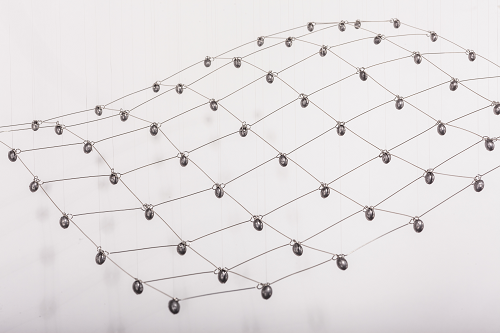
Malla Electrocinética I, 2002-2004
© Atelier Elias Crespin
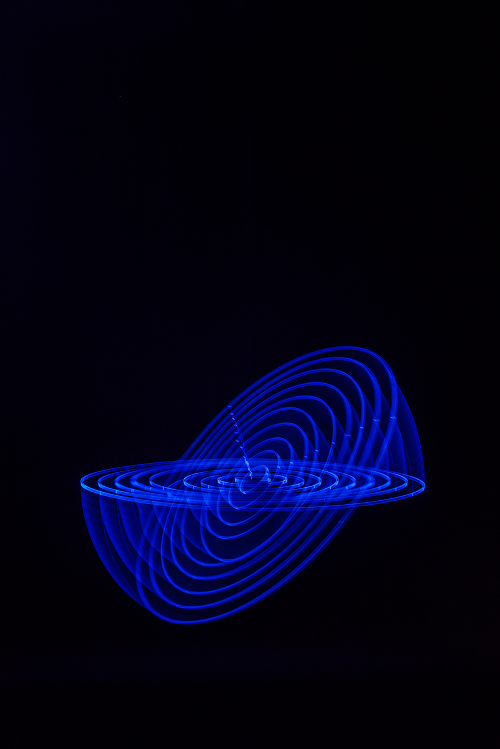
Circuconcéntricos Fluo Bleu, 2013
© Atelier Elias Crespin
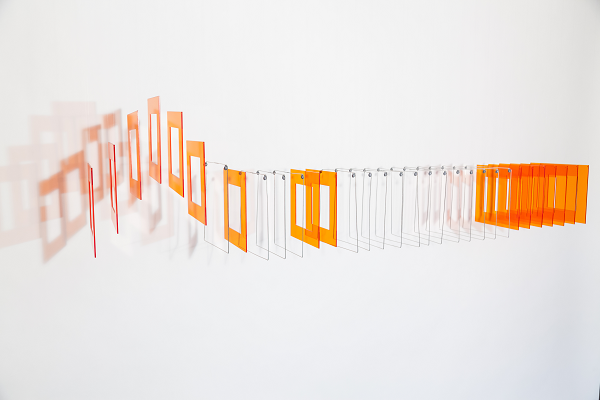
Tetralineados Orange, 2010
© Atelier Elias Crespin
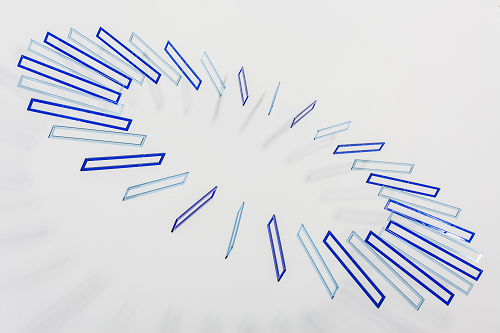
Plano Flexionante Circular Bleu, 2013
© Atelier Elias Crespin
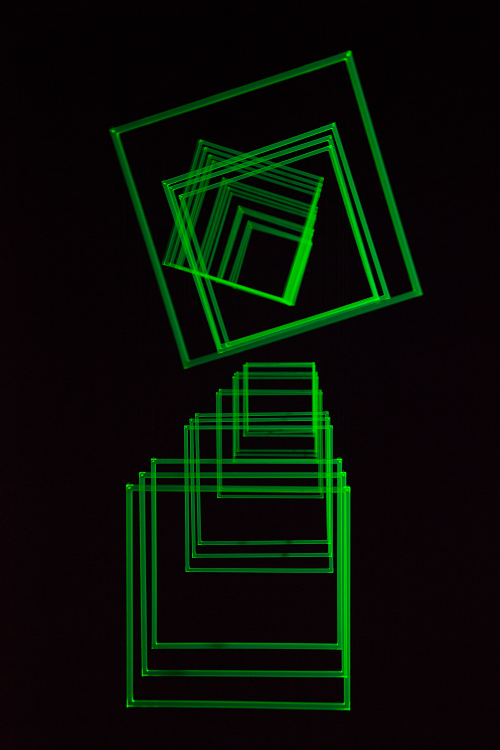
Tetralineados Fluo Vert, 2016
© Atelier Elias Crespin
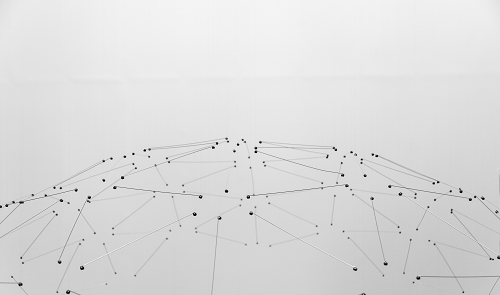
TriNet, 2011
© Atelier Elias Crespin
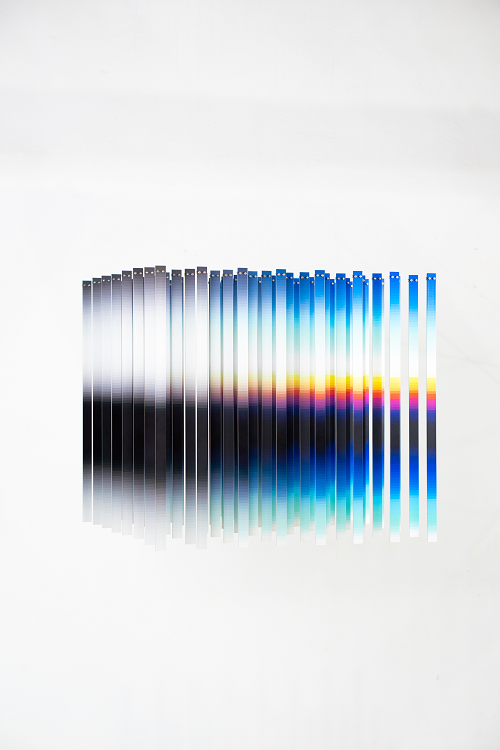
Cubo pantone, 2021
© Atelier Elias Crespin
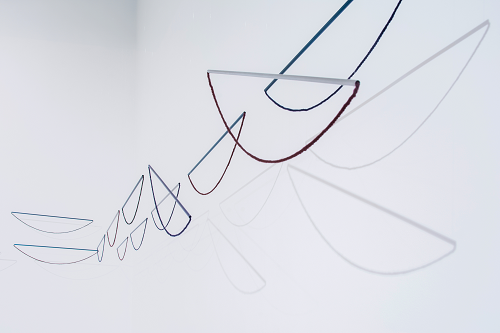
La Danza de las catenaria II, 2024
© Atelier Elias Crespin
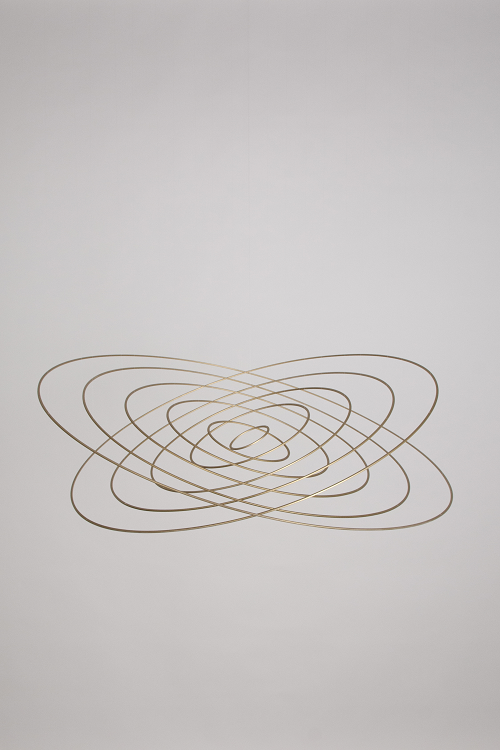
Circuconcéntricos Alu Dore, 2024
© Atelier Elias Crespin