
THE NIGHT.
Images of the night in Spanish Art 1981-2001
May, 7 – September, 16 2001
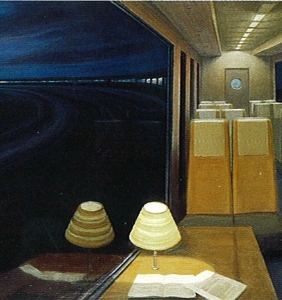
To paint the night is to paint the limit of the representable. In darkness, colors defy the retina, but they beat consistently and persuasively. Since Romanticism the night has become a subject of particular attention. Kant wrote that “The day is beautiful, but the night is sublime.” The depiction of the night landscape has undergone the same variations as artistic language and sensibility in the modern age. For this reason, in so far as we can only see what we know, the popularization of the discoveries of astrophysics have changed our perception of the heavens.
Divided into four categories: Stelar landscapes, Land (and sea) scapes, The incandescent night, and Phantasmagorias, this exhibition attempts to show what forty-four Spanish artists, born between 1943 and 1868, see in the night and how they depict it. The show concentrates, then, on the last two generations of creators whose artistic careers are already consolidated but, at the same time, it presents others who are in the initial stages of their trajectory. In this sense it is an anthology, but it is a very special anthology, not only because of the specialized criteria utilized in chosing the works, but also because of the additional fascination of its images which attempt to elicit emotion and enjoyment beyond the mere intellectual acquiescence of the viewers. During the decade of the 80s, there appeared a number of tendencies which presupposed a renovation of the artistic panorama in Spain, some of which heralded a kind of break with the previous generation. The decade of the 90s, on the one hand, consolidated these tendencies by distilling them and, on the other, it recovered and incorporated proposals that had previously been discarded. Among the artists present in the exhibition there are representatives of the most important movements of both decades, although the thematic criteria has limited the number of sculptural works to a minimum, which does not correspond to its importance during this period. It is renovated sculpture, as far as it refers to materials, language and attitudes. Arte Povera finds its echo in Jordi Barbi and Pamen Pereira, although she is not represented here as a sculptor. The sculpture of Blanca Muñoz and Juan Asensio corresponds to a more traditional criteria. Cristina Iglesias, however, works within a tradition in order to subvert it, tending towards the shifting terrain of installations, as in the case with Pedro Mora or Javier Pérez. The combination of sculpture and photography, one of the most fertile roads, is exemplified in the work of Daniel Canogar. Soledad Sevilla, a pioneer in the creation of installations, is present with one of her characteristic analytical compositions. The new figurative tendency at the beginning of the 80s became consolidated around Carlos Alcolea, Carlos Franco and Pérez Villalta, but it also incorporated artists such as Alfonso Albacete, Herminio Molero and Chema Cobo. From then on the options became diversified: reformulations of Pop Art, Pittura Metafisica, Magical Realism… Dis Berlín went through almost all of them, and Barceló, went off on his own, delving into Neo-Expressionism. Other Neo-Figurative artists who came later on and with a different set of proposals were María Gómez, Juan Carlos Savater, Isidre Manils and El Hortelano. In the decade of the 90s there began to emerge artists such as Antonio Rojas, Joaquín Risueño, Angel Mateo Charris, Gonzalo Sicre, Miguel Galano, Chema Peralta and Jorge Fin, who took up the earlier roads of European and American figurative painting during the middle of the century which had attracted the previous group. But if we go back to the beginning of the 80s, another pictorial group begins to define itself more clearly. A new abstraction emerges, represented by José Manuel Broto, Carlos León or Mon Montoya, more abstract expressionistic, while others such as Miguel Ángel Campano are more geometric abstractionistic, and the work of Juan Uslé also leans toward this tendency. José María Sicilia and Darío Urzay represent the conjunction between the figurative and the abstract, based in the organic and, in the case of Diego Moya, in the atmospheric. In the decade of the 90s, abstraction is represented by José Manuel Ciria and Javier Riera. Nevertheless, as is always the case with this type of classification, not all the pieces fit together. Carlos Pazos and Miguel Ángel Blanco, for example, waver between the sculptural and the poetic treatment of objects. The same is true of the painting of Perejaume. Zush has maintained his originality, in spite of his coincidences with the figurative tendencies of the early 80s. Something similar happened to Victor Mira who began with Informalism, although his current work can be placed alongside the expressionism of Miquel Barceló. This last painter, Barceló, is represented in this exhibit with the painting included in the VII Documenta of Kassel in 1982, a work that launched his International career. Another painting, also in this exhibition, Is by Javier Pérez, one of the two Spanish artists selected to represent this country at the next Venice Bienale, thus illustrating the purpose of a strictly contemporary criteria for this show.
Sponsored by Fundación Caja Madrid.